Unmanned aircraft are a vital asset in today’s world. They have made aerial photography and videography cheaper and more accessible to both hobbyists and small business owners.
Today, the major hurtle is UAS integration into national airspace (NAS). One of the major aspects to integration of UAS into NAS is the ability for systems to sense and avoid other aircraft or obstacles. In the current FAA regulations, the term “see and avoid” exist, but in the future “sense and avoid” will be applied (Carey, 2013). Until that point UASs are unable to comply with the requirements, but this has not stopped companies and the military from working towards smart solutions to the providing a sense and avoid system that are dependable enough to garner FAA approval and support.
The techniques for monitoring separation from both manned and unmanned systems come in multiple forms. The overarching concept, regardless of technique, is that the UAS is informed of nearby traffic and can execute a predictable solution that will provide regulatory separation. The two major techniques to gathering this traffic information can be categorized as ground based or airborne based sensing. Ground based sensing utilize radar systems similar to air traffic control agencies. The major difference is that these radar systems integrate directly into the ground control station (GCS) of the UAS (SRC Inc. 2016). The airborne technique relies on advanced sensors being equipped directly on the air vehicle portion of the UAS. A lot of research is going into the development of micro radar systems that would be able to fit a highly capable radar system into a very small package (Gorwara, 2014).
Some of the major considerations that need to be factored in when deciding between ground based sensing or airborne sensing needs to be attributed to both the size and type of UAS airframe in questions. Small UASs need to be very cognizant of size power and weight of any additional sensors that need to be added to the air vehicle. These systems may benefit from a ground based system that is able to communicate with the ground control station. Additionally, micro radar systems are being produced to provide small quadcopter sized UASs with a robust ability to sense and avoid traffic with light weight and low power solutions (Gorwara, 2014). Large UASs like military grade UASs have a large payload capacity and a large power source capable of both carrying and powering complex sensors that can provide adequate sense and avoid capabilities. Another aspect to consider is the type of airframe in question. A small quadcopter may move slowly and within a relatively small range. This means less powerful sensors could be used to provide the separation and spacing required. Large fast fixed wing system could fly at high altitudes and at high speeds with an enormous range, so providing powerful onboard solutions may make the most sense.
Some larger systems like the MQ-4 global hawk actually have terminal collision and avoidance system (TCAS) which is used on most large commercial manned aircraft. There is also research into a new system call Airborne Collision Avoidance System for Unmanned Aircraft or ACAS Xu for short. This system will integrate with TCAS as well as provide autonomous functions that will support proper sense and avoid decision making if the UAS has lost link or is in autonomous flight (NASA, 2015).
Another current initiative is the use of a system called the ground based sense and avoid system (GBSAA) by SRC Inc. This system is currently being installed by the US Army at posts that are hubs for large UAS training. Fort Hood and Fort Campbell are both test beds for this technology (Mishory, 2016). The system utilizes powerful and expensive ground based radar dishes to directly communicate any traffic advisories directly to the GCS of the UASs operating within its area of responsibility. This system can detect both manned and unmanned aircraft as well as other airborne obstacles. The benefits of this system are that just one GBSAA can provide coverage for multiple aircraft working in a defined area. Also, GBSAA does not add any additional power or weight requirements to the actual air vehicles that are utilizing its information (SRC Inc., 2016).
Regardless to size and type, the need for FAA approved sense and avoid systems is vital to the integration of UAS into NAS. By understanding the limitations and capabilities associated with the size and type of a UAS will help engineers provide the best solution to each system on a case by case basis. The need to ensure the right capability is equipped on the right system is also vital in reducing excess costs and ensuring the general UAS user base is capable and willing to equip their UASs with these systems when it becomes available. Additionally, integrating the UAS sense and avoid technology into manned sense and avoid systems like TCAS will be vital to future integration.
References
Carey, B. (2013, June 22). FAA Plans Unmanned 'Sense and Avoid' Rule in 2016. Retrieved
October 03, 2016, from http://www.ainonline.com/aviation-news/air-transport/2013-07-22/faa-plans-unmanned-sense-and-avoid-rule-2016
Gorwara, A. (2014). Doppler micro sense and avoid radar. Retrieved October 3, 2016, from http://pmi-rf.com/documents/DopplerMicroSenseandAvoidRadarPaper.pdf
Mishory, J. (2016, June 16). Initial UAS flights using GBSAA system at Ft. Hood have been delayed. Retrieved October 03, 2016, from https://insidedefense.com/daily-news/initial-uas-flights-using-gbsaa-system-ft-hood-have-been-delayed
NASA. (2015, January 25). NASA, FAA, Industry Conduct Initial Sense-and-Avoid Test. Retrieved October 03, 2016, from http://www.nasa.gov/centers/armstrong/Features/acas_xu_paves_the_way.html
SRC Inc. (2016). Ground-Based Sense and Avoid Radar System. Retrieved October 03, 2016, from http://www.srcinc.com/what-we-do/radar-and-sensors/gbsaa-radar-system.html
Showing posts with label lost link. Show all posts
Showing posts with label lost link. Show all posts
Tuesday, October 4, 2016

Friday, May 15, 2015
Implementation of an Unmanned System for Law Enforcement Surveillance
The use of unmanned aerial system by law enforcement has
been a hot button topic over the past few years. The legality of 4th
amendment searches, as well as the ethical questions raised when using UASs
have plagued law enforcement agencies for years. In the below proposal, I will
present a strategy that my help bring the T-Hawk UAS into the front line for Florida
law enforcement.
The UAS I have selected to use in my implementation strategy
is the T-Hawk by Honeywell. The key to this platform is its ease of use,
safety, and ability to fly in multiple weather and environmental conditions. This
particular platform has been used for years by law enforcement because of its
capable electro-optic/ infrared capability (EO/IR). In order to create a successful implementation
strategy, I will look at the following aspects; privacy, ethics, safety, and
lost link capability.
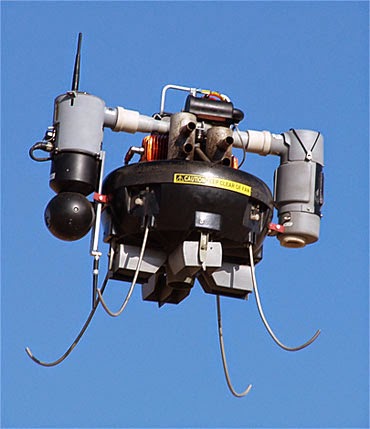
Privacy: The T-Hawk is a gas powered vertical take off
ducted fan style UAS. It is capable of flying up to 10,000 feet and at 46 miles
per hour for up to 50 minutes at a time. The system has a hover and stare
capability that makes it ideal for monitoring and search operations. Due to the
system being gas powered, it is rather loud and noticeable (often called a
flying lawnmower). The fact that this system is loud when it flies is actually
a positive in terms of the debate over privacy. Due to the fact that most
people within visual range of the system can hear it, means that it provides a
similar aspect of privacy as a manned helicopter. For most people, the idea of
the system being able to see you only when you can hear it provides a level of acceptable
privacy, because they are aware of its presence. For some smaller systems that
are battery powered and unable to be heard, people feel like they are being
unfairly violated and unable to avoid surveillance.
Ethics: Along with privacy the idea of the ethical nature of
UASs is still a hot button topic. Florida was the first state to pass the law
that limits UAS use by law enforcement. The “Freedom from Unwarranted Surveillance Act”
went into effect in Florida on July 1, 2013. The root of this act ensures all
UAS surveillance by law enforcement requires a warrant. The only exception is
if someone’s life is at risk or an imminent threat of a terror attack exists. Currently,
as long as law enforcement agencies follow this piece of legislation, there
should be a minimal ethical issue. In the future, as UAS rules change, I feel
that these rules should and will be changed, but as long as the law enforcement
agencies operate under the current federal and state laws, then they will be successful.
Safety: The T-Hawk is a relatively small UAS. The key to
safely employing this system would be based on a three part plan. The first two
steps would include rigorous operator training and aircraft preventative maintenance.
These two aspects are key to all aviation safety, and if done correctly will
ensure the system is flown in the correct airspace, under the right performance
constraints, and free of mechanical defects. The third part would be to only
operate the system at what the FAA determines to be a safe location and
altitude. In the field of UAS, operators should not strive for zero risk, but
should strive to reduce unnecessary risk in all aspects of operations.
Lost Link: Due to the automated nature of the T-Hawk, lost
link is less of an issue than other smaller manually controlled UASs. The
system can be set with a lost link time limit that automatically issue a return
home command. The system can be set to climb to a set return home altitude and
then make its way back and land vertically at the initial launch point. One positive
to this system is its capability of vertical flight. This will prevent the
system from having to make complicated traffic patterns in order to land and
will provide a very predictable lost link flight path. Additionally, to add
another level of safety to lost link operations, a clearly published standard
operating procedure and training will be essential to ensure the system does
what is expected every time.
In conclusion, UAS hardware and software is not the key
aspect to a successful implementation plan. The key is sufficient operator and maintainer
training, publishing of standard procedures, and compliance with local and
national laws. If a law enforcement entity spends the appropriate time and
effort accomplishing those three things, the ethical and moral issues should be
easy to justify and the safety and lost link concerns should be of minimal
concern.
References:
Subscribe to:
Posts (Atom)