Showing posts with label safety. Show all posts

Wednesday, August 17, 2016

Sense and Avoid Technology for UASs... Risk Mitigation vs. Complete Risk Avoidance

The integration of unmanned aerial systems (UASs) into national airspace (NAS) has been an ongoing process that is slowly but surely making small steps to a future filled with UASs. There are multiple facets that make integrating UASs into NAS a complicated process. Questions that deal with aircraft registration, operator training, ethical responsibility, hacking and lost link procedures are all on the table when it comes to integration into NAS. One topic that has been at the front and center of the integration process is sense and avoid standards and responsibilities for UASs. Companies like Amazon, Google, and Intel are all working solutions to this challenge, but the Military and government entities like NASA are also looking for solutions to getting more robust sense and avoid technology into the skies fast.

Currently in Part 91.113 of the federal aviation regulation, it lays out the rules of the sky in terms of right of way for all aircraft. One key verbiage used is that aircraft must “see and avoid”. This does not include the ability to sense and avoid, which is the method by which a UAS would accomplish this same task. Due to this, these regulations are very limiting to UAS operation. For military UAS this means that we must have visual observers that are trained and qualified observing the aircraft at all times while operating in NAS. This creates a huge logistical addition to typical training missions and is a cumbersome task to accomplish when it comes to personnel and crew management. It is reported that the FAA is attempting to alter Part 91.113 this year in order to include sense and avoid technology as a legal substitute for see and avoid (Carey, 2013).

The Army specifically has been working with a ground based sense and avoid system (GBSAA) to augment their ability to fly in NAS. I have worked with this technology during my time as a UAS commander in the Army and have seen how beneficial proper implementation could be for units stationed in the US. GBSAA works very similarly to ground based ATC radar systems, the only difference is that it is completely dedicated to a particular UAS mission. The radar picture of both participating and non-participating aircraft is collected via LSTAR ground sensors and overlaid on the ground control station’s display and moving map that is utilized by the operator to navigate the UAS (SRC Inc., 2016). When fully functional and approved by the FAA, this system would allow the Army to fly large UASs through Military Operations Airspace (MOA). For locations like Fort Campbell, Kentucky, this would greatly expand the operational area for the multiple UAS units stationed there. 

Depiction of Ground Based Sense and Avoid System by SRC Inc. 

In the civilian sector, there is a greater focus on autonomous sense and avoid capabilities. This technology will allow for smaller UASs to go further and farther than ever before. For companies like Amazon, who want to be able to deliver merchandise via UAS, it will be imperative that they can utilize autonomous drones that will legally be authorized to travel beyond line of sight as long as they are equipped with autonomous sense and avoid technology (Popper, 2016).

Regulators are attempting to find a perfect answer to the sense and avoid issue, but the technology is currently very good, but not perfect. Some argue that the technology needs to be better, while others argue that aviation has always been about risk mitigation and not risk avoidance. Companies like Intel have produced sense and avoid systems that could reduce risk nearly to zero, but not promise a perfect solution to every scenario (Popper, 2016). Many feel that the same risk acceptance levels applied to manned aviation should be carried over to unmanned aviation rather than attempting to create a more stringent and difficult standard to achieve. What do you think is the best way forward? Please feel free to respond in the comments section below.    

References:

Carey, B. (2013, July 22). FAA Plans Unmanned 'Sense and Avoid' Rule in 2016. Retrieved August 17, 2016, from http://www.ainonline.com/aviation-news/air-transport/2013-07-22/faa-plans-unmanned-sense-and-avoid-rule-2016

FAA. (2004). Part 91 GENERAL OPERATING AND FLIGHT RULE. Retrieved August 17, 2016, from http://rgl.faa.gov/Regulatory_and_Guidance_Library/rgFAR.nsf/0/934f0a02e17e7de086256eeb005192fc!OpenDocument

Popper, B. (2016, January 16). What's really standing in the way of drone delivery? Retrieved August 17, 2016, from http://www.theverge.com/2016/1/16/10777144/delivery-drones-regulations-safety-faa-autonomous-flight

SRC Inc. (2016). Ground-Based Sense and Avoid Radar System. Retrieved August 17, 2016, from http://www.srcinc.com/what-we-do/radar-and-sensors/gbsaa-radar-system.html

Friday, May 15, 2015

Implementation of an Unmanned System for Law Enforcement Surveillance

The use of unmanned aerial system by law enforcement has been a hot button topic over the past few years. The legality of 4th amendment searches, as well as the ethical questions raised when using UASs have plagued law enforcement agencies for years. In the below proposal, I will present a strategy that my help bring the T-Hawk UAS into the front line for Florida law enforcement.

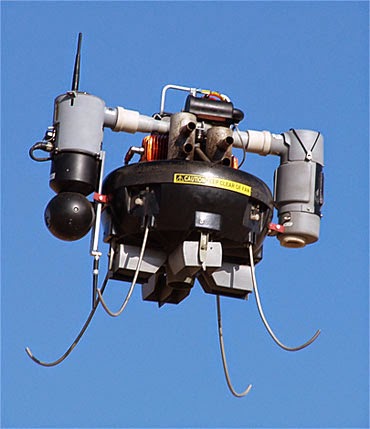
The UAS I have selected to use in my implementation strategy is the T-Hawk by Honeywell. The key to this platform is its ease of use, safety, and ability to fly in multiple weather and environmental conditions. This particular platform has been used for years by law enforcement because of its capable electro-optic/ infrared capability (EO/IR).  In order to create a successful implementation strategy, I will look at the following aspects; privacy, ethics, safety, and lost link capability.


Privacy: The T-Hawk is a gas powered vertical take off ducted fan style UAS. It is capable of flying up to 10,000 feet and at 46 miles per hour for up to 50 minutes at a time. The system has a hover and stare capability that makes it ideal for monitoring and search operations. Due to the system being gas powered, it is rather loud and noticeable (often called a flying lawnmower). The fact that this system is loud when it flies is actually a positive in terms of the debate over privacy. Due to the fact that most people within visual range of the system can hear it, means that it provides a similar aspect of privacy as a manned helicopter. For most people, the idea of the system being able to see you only when you can hear it provides a level of acceptable privacy, because they are aware of its presence. For some smaller systems that are battery powered and unable to be heard, people feel like they are being unfairly violated and unable to avoid surveillance.

Ethics: Along with privacy the idea of the ethical nature of UASs is still a hot button topic. Florida was the first state to pass the law that limits UAS use by law enforcement.  The “Freedom from Unwarranted Surveillance Act” went into effect in Florida on July 1, 2013. The root of this act ensures all UAS surveillance by law enforcement requires a warrant. The only exception is if someone’s life is at risk or an imminent threat of a terror attack exists. Currently, as long as law enforcement agencies follow this piece of legislation, there should be a minimal ethical issue. In the future, as UAS rules change, I feel that these rules should and will be changed, but as long as the law enforcement agencies operate under the current federal and state laws, then they will be successful.
   
Safety: The T-Hawk is a relatively small UAS. The key to safely employing this system would be based on a three part plan. The first two steps would include rigorous operator training and aircraft preventative maintenance. These two aspects are key to all aviation safety, and if done correctly will ensure the system is flown in the correct airspace, under the right performance constraints, and free of mechanical defects. The third part would be to only operate the system at what the FAA determines to be a safe location and altitude. In the field of UAS, operators should not strive for zero risk, but should strive to reduce unnecessary risk in all aspects of operations.

Lost Link: Due to the automated nature of the T-Hawk, lost link is less of an issue than other smaller manually controlled UASs. The system can be set with a lost link time limit that automatically issue a return home command. The system can be set to climb to a set return home altitude and then make its way back and land vertically at the initial launch point. One positive to this system is its capability of vertical flight. This will prevent the system from having to make complicated traffic patterns in order to land and will provide a very predictable lost link flight path. Additionally, to add another level of safety to lost link operations, a clearly published standard operating procedure and training will be essential to ensure the system does what is expected every time.

In conclusion, UAS hardware and software is not the key aspect to a successful implementation plan. The key is sufficient operator and maintainer training, publishing of standard procedures, and compliance with local and national laws. If a law enforcement entity spends the appropriate time and effort accomplishing those three things, the ethical and moral issues should be easy to justify and the safety and lost link concerns should be of minimal concern.

References: